Should I Start With the Melody or the Harmony?
This is a common question when learning to compose music. The answer is a simple one. You need to start with both.
How Do I Start with Both Melody and Harmony?
Let me stat out by asking you a question. If you were to write a simple melody as follows:
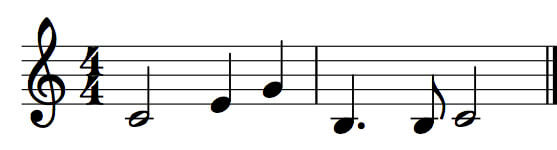
Are you writing the melody first? Yes. But you are also writing the harmony first. Let me explain.
The Melody Should Outline The Harmony
As a beginner composer, it is important to be specific about what you write. The reason for this is you are still learning the craft. Practicing specificity in the music you compose teaches you an important thing, how not to be ambiguous.
Ambiguity is an effect that could be used deliberately for certain effects, but we are not concerned about that here. For our purposes in learning how to compose music, ambiguity is our enemy. We do not gain any experience from just throwing down notes on a piece of paper.
So back to the above example.
You will notice in the first bar, three specific notes are played.
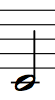
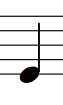
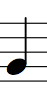
C E and G
With just these three notes, it is very clear what the harmony is, the tonic, especially as they are at the beginning of the composition. But after these notes, there is another, very specific figure that helps us outline the harmony as well.
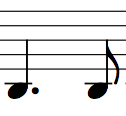
If we call these two notes by their scale degree name, the leading tone, then it is also very clear what the harmony should be, V or dominant.
And then of course, it goes back to the tonic scale degree after this.
So we end up with this:
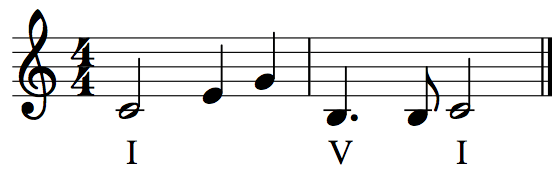
The point I am trying to make is you can approach a composition horizontally, writing a melody first, or you can approach it vertically, writing the harmony first. But, if you really want to make leaps and bounds in your composing, you should practice composing non-ambiguous music, that takes into account both melody and harmony at the same time. This will help you hone your skills and give you the resources to flesh out what you hear in your head.
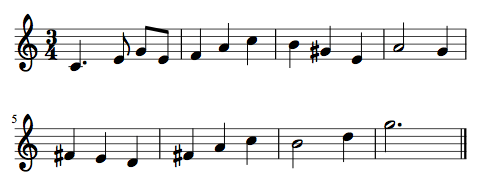
As an exercise, see if you can fill out the harmony in this melody below.
Let me know what you think.
You can also check out these related articles:

If my guitar harmony is playing C (tonic) for 1 bar, should my melody avoid hitting an A note. Should I only stick to 1-3-5 in the melody to avoid ambiguity?
Think of A over the C chord as creating tension that can be resolved by moving that A back to a G. You don’t have to make your melody only out of the chord tones, but you should understand how they lay out structurally and how non-chord tones relate.
thank you for this article
Hi I enjoyed the exercise. I to write scores for movies and variouse other projects. I am always looking to network, learn and share knowledge. If you would like please contact me at [email protected] maybe we could both grow our networks.
-alex lee
Hi,
I was looking at the musical stage where you show the tonic notes and then the dominant note (V). I don’t understand. The dominant note is the 5th degree of a musical scale; and on the first staff written on the top of the page, the dominant is noted as the 4th note. I don’t understand. Is the 4th note considered the dominant if it is a dotted note?
Thank you
The dominant is always the 5th degree of the scale, but depending on the key and the clef it can be different notes.
That example confused me, too. If we take our tonic to be C, a B would be not a dominant, but a seventh. So unless there is some trick I’m missing, the harmony analysis is wrong.
Ira,
The B leading to C right before the end of the theme implies a dominant chord. The viiº chord is not nearly as frequent as the V chord in a cadence.
Can you help me understand how to write a composition with the melody and harmony intertwined without writing horizontally or vertically?
Thanks for the question.
I have a general answer that I think will help you. Please note that many of these can be done concurrently. For instance, I recommend learning to read music while learning to play an instrument.
On to the answer:
I have many resources on this site that are devoted to learning composition:
Get a solid base in reading music and playing some kind of instrument.
I would also highly recommend practicing ear training and transcription. This ability will help strengthen your ability to audit. Audiation is the process of being able to understand music that you hear in your head. This means a melody or chord progression that you imagine.
It comes down to putting in the time to truly understand the craft of composition. If you put in the effort, I can teach you.
Oh yes, this is such a fascinating topic, one we could spend a lifetime ruminating over. In your example, you provide 6 notes. It could be argued that these 6 notes – written as they are – have no place in a piece of music other than the fact that one can join any 6 notes together, but that a real composer would replace the D for example with an Eb, and I can think of examples where the chord of F has been played, but the solo note is E that has no place in the F chord, but nevertheless creates a unique harmony.
But to get back to the topic, let’s suppose you assembled in a room Beethoven, Tchaikovsky, Brahms, Mahler, Shostakovitch, Webern, Stravinsky, Wagner, and any other composers you can think of, including jazz, rock and folk musicians, how would each of them approach your 6 notes?
It’s like giving a writer 6 words and asking him to write a story. He might ask: who is the intended audience, after all, there’s little point in writing unless there are readers. Likewise, our composers might ask what are you attempting to achieve, is it the beginning of a grand symphony, or a nursery rhyme, or something to get people to dance to, or is it for an X-factor contestant, or is it film music?
If you know what you are composing for, then this will influence the harmonies and the overall structure. Will those 6 notes be better positioned inside a piece of music because a composer might say, these 6 notes are inconsequential, what counts is the next note because that will turn an otherwise inconsequential piece of music into a sensational masterpiece, and if you want to understand that, listen to the last movement of Mahler’s 2nd symphony, when a minute or so into it, an abrupt change in key marks the beginning of perhaps one of the most profound endings of any piece of music I’ve ever heard.
Very good points.
Hello. I was wondering, if my melody is not harmonic, would I need to put spots between melodies to create another melody, to make it MORE harmonic? Or would that make it LESS harmonic? This really is a stumping question to me.
I am not quite sure what you are saying here. If your melody doesn’t reflect a specific harmony, you can still harmonize it, either through homophonic writing (chords) or contrapuntally (a counter melody).
Hey Jon,
I’m 17 and love composing and I’m finding incredibly useful to look around your site. Thank you!
I’ve written it with a simple chord per harmony – to me it sounds like it could be pop ballad kinda thing. I’ve over explained each chord but I’d love to know if I’m on the right lines.
I (C major), IV, III (E major – I to IV sounds like a popular music progression so using E major can keep this going), A minor (although with a flattened 7th to keep the tone weak – E major could be a secondary dominant for this chord), D major (treating A minor as another dominant – the implied false relation of the F you’d expect in A minor with the F sharp of D add some colour to the modulation to the picturesque major D sus feel), D major 7th (tension is extended towards the cadence), G major, G major 7th (this would mirror the previous to bars and imply that the melody could repeat or a have a nice variation).
Thanks 🙂
Sorry
* I’ve written it as a chord per bar – hope that clears me comment up!
Glad you like the site.
Hi there…In the first 2 bar melody at the top isn’t the B, leading tone, the vii degree of the scale, with G being the V or dominant? Maybe I’m misunderstanding the way you are speaking about it.
With the leading tone, you could in fact use either harmony. The point is that a harmony is implied. With a basic idea, the I-V-I progression is very common, so it would probably be a little more natural to fall into that progression.
I see what I missed now – leading tone doesn’t mean first note of the chord (if it’s chord harmony) but could be GBD, EGB or BDF (V, iii or vii(d)). Total Beginner still. Thank you!
Could you help me understand more clearly of what you are saying. I’m not quite following. Thank you 🙂
Audra, I would recommend reading through some of the articles on the site, as you’ll have a slightly different angle on the subject.
Audra, I *think* what Anon Non is saying is:
The little musical piece in question has the following notes being played:
C E G and then B B C
and they’re trying to decide which chord gets played while playing those notes.
for the C E G, it’s pretty simple, since those 3 notes form the triad that makes up the C-Major chord. So, you can play the C-Major chord the entire time you are playing those 3 notes.
for the B B C, it’s not as easy. and, let’s just look at the B for now.
we want to find a chord (in the key of C-Major) that has the note B in it.
Anon Non lists those 3: BDF, GBD and EGB. (Note that the other 4 chords in that key are ACE, CEG, DFA and FAC, none of which have a B note in them, so they don’t work here).
The second one of those 3 (GBD) is the 5th chord in the C-Major scale, so we have a I-V chord progression so far.
Jon then points out that a I-V-I chord progression is pretty commonly used.
Since the final note is a C, we can go ahead and just play a C-Major chord underneath it, and so we end up with that I-V-I chord progression that Jon referred to.
Does that make sense? I’m pretty new to this stuff too, so I hope I didn’t explain this in an incorrect or confusing way.
Good luck. 🙂
The leading tone is basically the “almost tonic” tone/note. In say a C major scale, B would be the leading tone. Just like that song in The Sound of Music says, “Ti, you eat with jam and bread, and that leads us back to Do.” In the Do Re Mi scale system, Ti is the leading tone going back to Do, the tonic.
Using a C major scale (C,D,E,F,G,A,B,C), triads (3-note chords) built by superimposing 3rd intervals, can be built on each lettername. Each triad derived from a major scale has a major or minor quality with the exception of the triad built on the 7th step. For example C-E-G is major and D-F-A is minor. The triad built from step 7 is B-D-F (diminished). Since this triad is neither major or minor, it can’t represent a major or minor key. So, ignore that one for now.
The remaining major and minor triads built on top of D,E,F,G,A, can each be preceded by their own V (OR any form of V). Precede Dmi with A7, Emi with E7, F with C7, G with D7, Ami with E7. This applies to all and any of the major and minor chords of a key, both major and minor keys. These dominant chords strengthen the chord progressions into the non-tonic chords of the key. Since their destination is to a major or minor chord, they are also used to change the key into that destination chord quality (modulation). That is, you can continue writing in your original key after the progression or in the key of the destination chord. Of course, modulation depends on where you are in the structure of your work.
Hi, I think it was
I – IV – III – vi
II – II – V – V
>//<
That is correct. I prefer to write the II as V/V to show that the V is being tonicized with it’s own dominant. Thanks.
Thanks, but I don’t know about “Write the II as V/V to show that the V is being tonicized with it’s own dominant”. I don’t understand what it means.
He means that the II chord can instead be rewritten as the V chord of the V chord. For example:
In the key of C, the II chord is d-minor, but you can flip it to a D-major if you instead treat D as the the V of G, which is normally the “dominant” or V chord of C. By playing the dominant V chord of G–i.e., the D-major–the G becomes more like the tonic.
Very well put. Thank you.
It might be helpful to link a resource for the Roman numeral notation for those who never had that as part of our musical education. Wikipedia covers a lot of it, but the article in its current format is rather haphazard in organization.
thanks dude.
Interesting that you heard this as a minor melody. In that case, your harmonization would be fine. The best thing you could do for the second phrase, would be to have a D7 or V/VII as a pivot chord, and then end on a G.
I originally composed this as a major melody.
The harmony being I – IV – III# (V/vi) – vi.
The second phrase was still V/V – V – I.
Thanks for the different viewpoint.
im sorry i mmean i,VI,V,i
hi
i think that the harmony for the first line should be like this:
Am ,F ,E ,Am since the melody is writen in a minor key
i ,VI ,VII,i
but regarding the second line i didnt know what to do cause i dont know the proper harmony for melodic minor .
my problems began with F sharp.
can you explain pls.
On this lesson along with the Start composing, I am curious how the note B in the C Major scale can be the V . I believe it should be the vii diminished. G is the V, isn’t it?
Hey Michelle,
The melody can be any of the chord tones in a specific harmony. So in this case, the melody being B, is the 3rd of V. You are correct though in saying it could be a diminished vii. Either one will work.
Of course Jon is quite correct. V is probably a more common harmonisation of the leading note in a melodic situation like this, but vii (especially in first inversion, i.e. vii6 (or viib, if you prefer)) is possible, and frequently occurs in Baroque music (especially Handel).